09 Oct 2026 · artificial intelligence · 6 min
Jev: the model that decides in milliseconds without writing text
What it is, in one paragraph
Jev is a model released on 15 September 2026 by TypeSafe AI, the startup of Diogo Almeida, one of the authors of the paper behind ChatGPT’s instruction tuning. It does not generate text. You hand it a state (a text, a JSON object, a table row) and a list of questions whose possible answers are defined in advance, and it returns a typed answer with an associated probability. The company calls the category “System One Model”, a reference to the fast, intuitive thinking described by Daniel Kahneman, as opposed to the slow reasoning that chat models perform while writing.
Update: three weeks later, independent audits measured the model on public data, and some numbers contradict the launch post. They are in Jev, three weeks later.
Why it exists
Much of the work people try to delegate to a language model is not writing, it is deciding: routing a ticket, deciding whether a message is a phishing attempt, choosing an agent’s next step, scoring risk. For that kind of task, asking for a paragraph of justification is expensive and slow, and it still forces the program to parse free text to find the decision.
Jev’s proposal is the inverse: the decision comes back ready for code to consume, with a confidence number next to it. According to TypeSafe, training uses a method of its own, RLCD (Reinforcement Learning for Calibrated Decisions), which optimises calibration instead of human preference: if the model says 80% likely, the goal is for it to be right in roughly 80% of cases over time. That differs from RLHF, which is trained to produce the answer a human prefers.
The three possible answers
Every question you ask the model falls into one of these formats, and nothing else:
| type | what it returns | example question |
|---|---|---|
| choice | one of the options you listed, with the probability of each | “is this message about payment, support, cancellation or sales?” |
| score | a value inside a scale you define | “from 0 to 4, how urgent is this ticket?” |
| proposition | the probability that a statement is true, between 0 and 1 | “is this e-mail a phishing attempt?” |
There is no free-text field in the answer. That is what allows the claim that the format cannot come out wrong: the set of possible outputs was defined before the call.
How to use it
Access is through an API. The documented entry point is a POST to https://api.typesafe.ai/v1/systemone, with the model jev-latest. The example below is illustrative, to show the shape of the request; check the exact format in TypeSafe’s documentation before integrating.
curl https://api.typesafe.ai/v1/systemone \
  -H "Authorization: Bearer $TYPESAFE_API_KEY" \
  -H "Content-Type: application/json" \
  -d '{
    "model": "jev-latest",
    "state": "Customer reports that the September invoice came with a different amount than the contract and asks for an immediate correction.",
    "questions": [
      {"id": "subject", "type": "choice", "options": ["billing", "support", "cancellation", "sales"]},
      {"id": "urgency", "type": "score", "min": 0, "max": 4},
      {"id": "churn_risk", "type": "proposition", "statement": "The customer is at risk of cancelling in the next 30 days"}
    ]
  }'
The calling program receives the decisions with their probabilities and decides what to do. The model does not write the reply e-mail or the ticket text; that remains a job for a chat model, when it is needed.
Where it fits well
- Support triage. Classifying and prioritising the queue before any writing happens. This is the case most cited in the documentation and in published analyses.
- Agent guardrails. Before an agent performs an action, asking whether the action matches the request. A fast boolean answer is more useful than a paragraph of analysis on the critical path.
- Output verification. Checking whether text produced by another model meets a condition (whether it quotes the right price, for example) and returning approved or rejected.
- Classification at volume. Labelling rows of a large text corpus, where cost per decision decides whether the project fits the budget.
- Moderation and filters. Deciding what passes, what goes to human review and what is blocked.
Where it does not fit
- Generating text, explaining, summarising or chatting. That is not what it does.
- Decisions that require long, open reasoning with written steps and justification.
- A question whose set of answers cannot be defined in advance. If the possible answer does not fit a list, Jev is not the tool.
Comparison with a chat model
| Jev | chat model | |
|---|---|---|
| output | typed value, usable by code as is | text that has to be interpreted |
| published latency | 70 to 500 ms | seconds per answer of a few paragraphs |
| billing | per input token, output free of charge | input and output both billed |
| format | defined in the call, no variation | free-form, subject to variation |
| weak point | does not write, does not explain, depends on calibration | cost and latency per call, and the decision must be extracted from text |
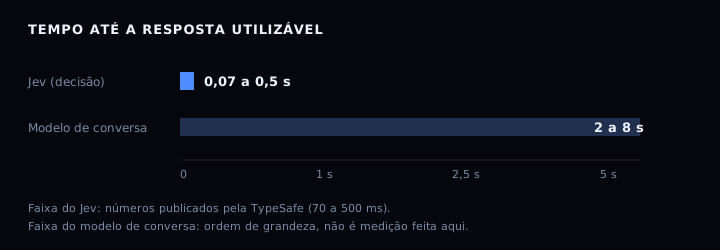
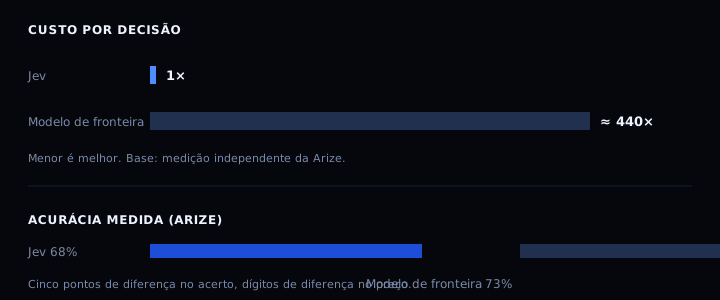
The latency and cost figures above are those published by TypeSafe. Arize published an independent measurement putting Jev’s accuracy at 68% against 73% for a frontier model of the same generation, and highlights cost as the central point: the accuracy gap is small next to the price gap per decision.
How I would evaluate it before adopting
- Build a set of closed questions with known correct answers, taken from your own history.
- Measure accuracy and calibration, not accuracy alone: when the model says 0.9, how often was it right? A confident and wrong model is worse than an uncertain one.
- Compare cost per decision with a chat model on the same set.
- Check whether the decision sits on the user’s critical path. If it does, millisecond latency changes the design of the application; if it does not, the gain is only cost.
- Only then choose where to use it. A new tool does not become architecture on day one.
The ecosystem around it
The launch came with an integration into Vercel’s AI Gateway, which reported usage by nearly 13% of paying teams in the first 24 hours. Within two weeks, open projects that train models for the same format appeared, such as OpenJev, along with libraries for measuring calibration, such as AnyJev. There is also a recurring criticism from part of the machine learning community that Jev’s function resembles classifiers and cross-encoders that already existed; what changed was the price and the latency, not the idea.
Worth following with healthy scepticism: the speed and cost numbers come from the company selling the model, and adoption is still recent.
Links
- TypeSafe documentation: docs.typesafe.ai
- What is Jev, by Vercel: vercel.com
- Independent measurement of accuracy and cost, by Arize: arize.com
- Practical usage guide, on DEV: dev.to
- Technical explanation, on DataCamp: datacamp.com
- Explanation in Portuguese: tecedi.com.br
- Analysis of the open ecosystem that appeared in two weeks: note.com
- OpenJev (open project): github.com
- AnyJev (calibration measurement): pypi.org